


BENTSAI 6205 & 6210 Handheld Inkjet Printers | 12.7mm/25.4mm TIJ Coding
Specifications
Details
Quick answer: Choose the BENTSAI 6205 series for codes up to 12.7 mm high, or the 6210 series for codes up to 25.4 mm high. B models are handheld-only; BL models also support sensor-triggered inline printing, subject to a suitable installation.
The BT-HH6205B, BT-HH6205BL, BT-HH6210B and BT-HH6210BL are thermal inkjet (TIJ) coding printers for factories, warehouses, contract packers and SMEs in Malaysia.
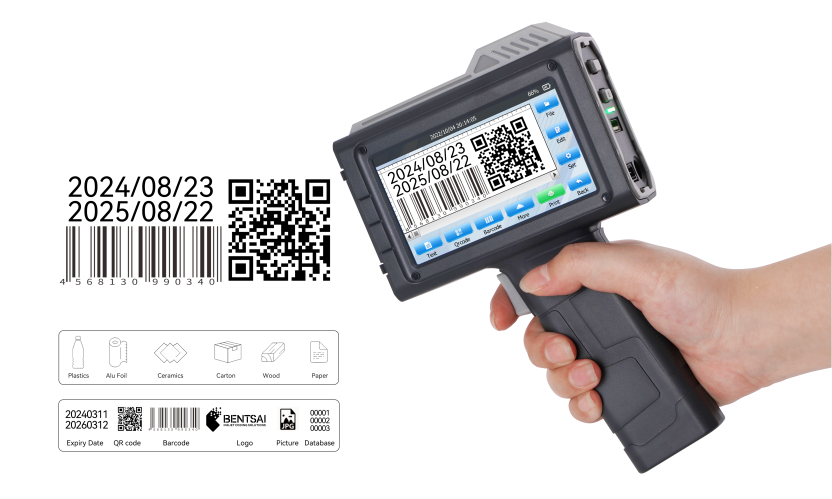
BENTSAI 6205 vs 6210: model comparison
| Feature | 6205B / 6205BL | 6210B / 6210BL |
|---|---|---|
| Print height | 2.5–12.7 mm; 1–5 lines | 2.5–25.4 mm; 1–10 lines |
| Resolution | 600 or 300 dpi | 300 dpi |
| Maximum print area | 12.7 × 406 mm | 25.4 × 406 mm |
| Maximum print speed | 30 m/min | 30 m/min |
| B models | Handheld only | Handheld only |
| BL models | Handheld and inline | Handheld and inline |
Specifications are based on the BENTSAI 6205/6210 series flyer. Manufacturer maximums are not guaranteed for every job. Actual results depend on message layout, resolution, ink, material, operator technique and line conditions.
Which model should you choose?
- Compact date and batch codes: consider 6205 when the complete message fits within 12.7 mm.
- Taller text or more lines: consider 6210 for layouts up to 25.4 mm. Larger print height does not automatically mean better barcode readability.
- Conveyor coding: choose a BL model and confirm product guidance, mounting, sensor position, print distance and actual operating speed.
See the BT-HH6205BL product page and BT-HH6210BL product page for model-specific information.
Print content and file formats
The series supports text, numbers, dates, batch codes, counters, serial numbers, logos, barcodes and 2D codes. Image formats: JPG, JPEG, PNG and BMP. Listed barcode formats include Code 128, Code 39, EAN-8, EAN-13, UPC-A, ITF 2 of 5, UPC-E and ITF-14. Listed 2D formats include QR Code, Data Matrix and GS1 Data Matrix. Verify the final message and test scanning with the intended reader on the actual packaging.
Ink and surface compatibility: test first
Water-based and solvent-based cartridges are available for different applications. Porous materials may suit water-based ink; selected non-porous materials may require solvent-based ink. Cartridge compatibility and local availability must be confirmed for the exact model.
Not every surface is suitable. Coatings, lamination, oil, moisture and texture can prevent ink adhesion. Test the selected ink on actual production samples for drying, rubbing and normal handling. Successful sample printing is not a guarantee of long-term durability in every environment.
Battery, setup and maintenance
The flyer lists two 2600 mAh 18650 lithium-ion batteries and up to 16 hours of operation. Actual runtime depends on usage, settings and battery condition. Follow the model-specific manual for charging, power connections and inline installation. The specified nozzle-to-object distance is 2–5 mm.
Cartridge-based TIJ printing is low-maintenance, not maintenance-free. Follow the manual for nozzle cleaning, cartridge capping and storage. Replacing a cartridge also replaces its integrated printhead. Confirm the included cartridge, roller, positioning plate, USB drive, power accessories and sensor with PTS for the package ordered.
Application guides
- Food and beverage packaging
- Carton and secondary packaging
- Warehouse and logistics
- Manufacturing parts and components
Actual 6205 sample test
View our BENTSAI 6205 customer sample-printing case. This illustrates a specific test, not a guarantee for every material or a confirmation of the BL variant.
Frequently asked questions
Can both series print expiry dates and batch numbers?
Yes. Confirm the message, code size and ink suitability before production.
Can all models work on a conveyor?
No. B models are handheld-only. BL models support inline operation with a suitable sensor and installation.
Will the ink adhere to coated packaging?
Not necessarily. Test the actual coating and selected cartridge before purchase or production approval.
Application support in Malaysia
PTS Technology Sdn Bhd is an authorised BENTSAI distributor for handheld and industrial inline TIJ printers and related consumables in Malaysia. Contact PTS with your sample material, coating details, required message, print height and handheld or inline workflow.
View more about BENTSAI 6205 & 6210 Handheld Inkjet Printers | 12.7mm/25.4mm TIJ Coding on main site